After a crazy first half of the year with work taking me to Madrid, Brisbane, Osaka, the Bay Area, and Las Vegas, I haven’t had as much time on the bike as I would like. But I’m itching for an adventure and some alone time on the bike. So I’ve planned a three day adventure before summer arrives.
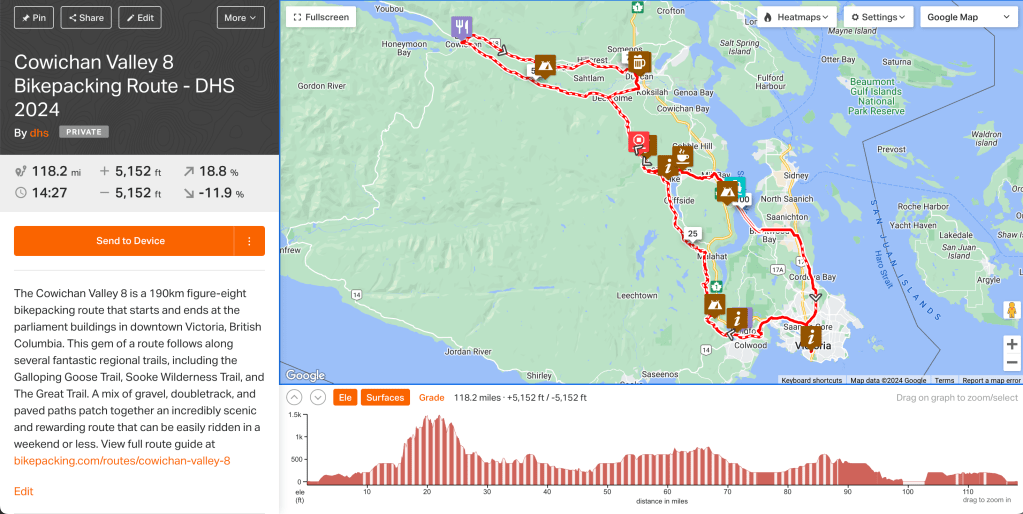
My plan is to catch the Victoria Clipper ferry to Victoria, BC so that I can ride the Cowichan Valley 8. I plan on riding the route in 3 days/2 nights, returning on the evening Clipper on Day 3.
Although the ride is non-technical and I could take my gravel bike, the Pink ‘Rona, I’ll be riding on Hobbes since I find it’s upright stance to be more comfortable overall. I recently upgraded the wheels on Hobbes to a set of Hunt Trail Wide MTB 29 along with the 2.6″ Vittoria Mezcal tires. I expect to have a nice and cushy ride.
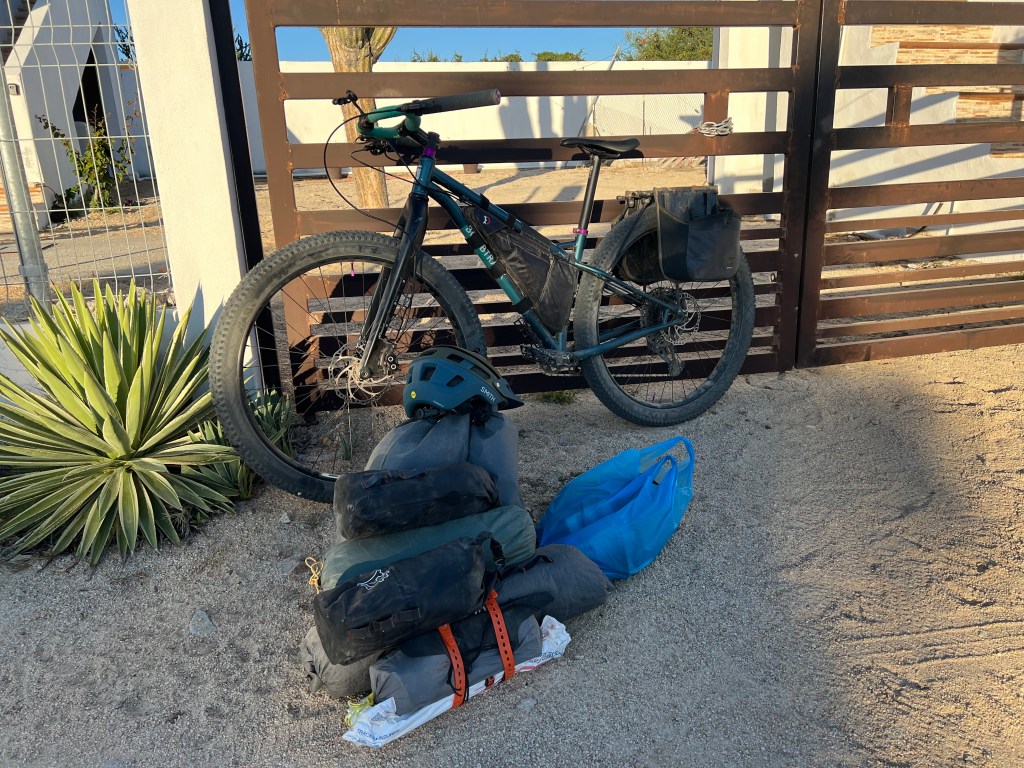
Packing is still a work in progress – I’m definitely taking a lot less gear than I did in Mexico. I haven’t exactly gone ultralight, but I did minimize my gear for this trip. I recently started using PackWizard to manage my gear, replacing the overly complicated spreadsheet that I had been using. While I can manage my pack in PackWizard, it doesn’t allow me to tag items with where I plan to store them since it’s designed for backpackers, not bikepackers. Oh well.
One of the benefits of this loop is that I’ll be able to spend two nights at the same campsite. Although day 2 of the ride has less climbing and mileage than I’ve planned on day 1, it will be nice to ride mostly unladen.
Normally, I don’t have any issues eating and drinking enough when bikepacking. That did not carry over to Baja, and I don’t know why.
First, keeping up with hydration was really hard. Even though I covered up with a long sleeve sun shirt to keep the direct sun off of my torso, arms, and neck, the sun was still hot. As a Seattleite in the middle of winter, even the 80 degree F/27 degee C weather was really hot for me. I always had plenty of water and/or Liquid IV, I was never running low enough to have to ration. When I refilled my water, I would drink as much as I could straight from my filter. Yet I consistently experienced some symptoms of dehydration every day.
The more significant issue was my inability to consume enough calories to keep going each day. I had a constant supply of snacky food – peanut butter, some honey sticks, cookies, peanuts, snickers – available to me while I rode. More often than not, I didn’t really want what I had. None of the food was appealing to me. When I sat down to eat, I wasn’t hungry even though I knew I needed to refuel my body. I expected to be ravenous, consuming larger quantities of food than normal, yet my intake was less than I eat normally at home. This was incredibly frustrating for me – I was free to eat whatever I wanted and yet I didn’t want what I had.
I don’t really understand why this was. Since my past bikepacking experiences were all overnighters, I could manage even if I wasn’t eating well. Not eating enough calories across multiple days was unsustainable. I was bonking, hard, and it began to impact my mood.
So what’s next? I don’t really know. I need to keep working on finding foods that I actively want to eat while bikepacking that are calorie dense and enjoyable to eat. Andrew Skurka has a few recipes I’ve used that I like, and Garage Grown Gear has been my go-to source for mostly enjoyable pre-packaged dehydrated meals. But this was not an option in Baja where I was trying to be self-sufficient and live off the land… er… local markets. Sorry, Ryan van Duzer and Baja Divide riders everywhere, but bagged beans served at ambient temperature were not that great!
I woke up early today, still dehydrated. A liter of water and an unheatlhy breakfast – the Snickers bar was the healthiest thing I ate this morning – and I was ready to head out the door.
Ready for the ride back to San José del Cabo.
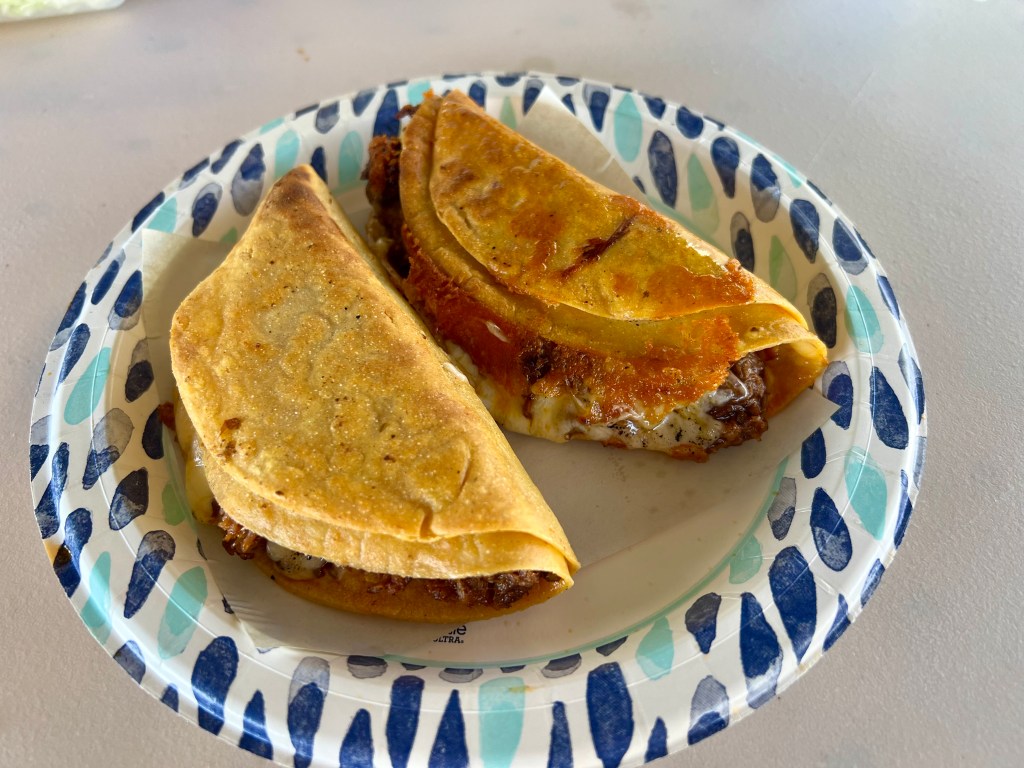
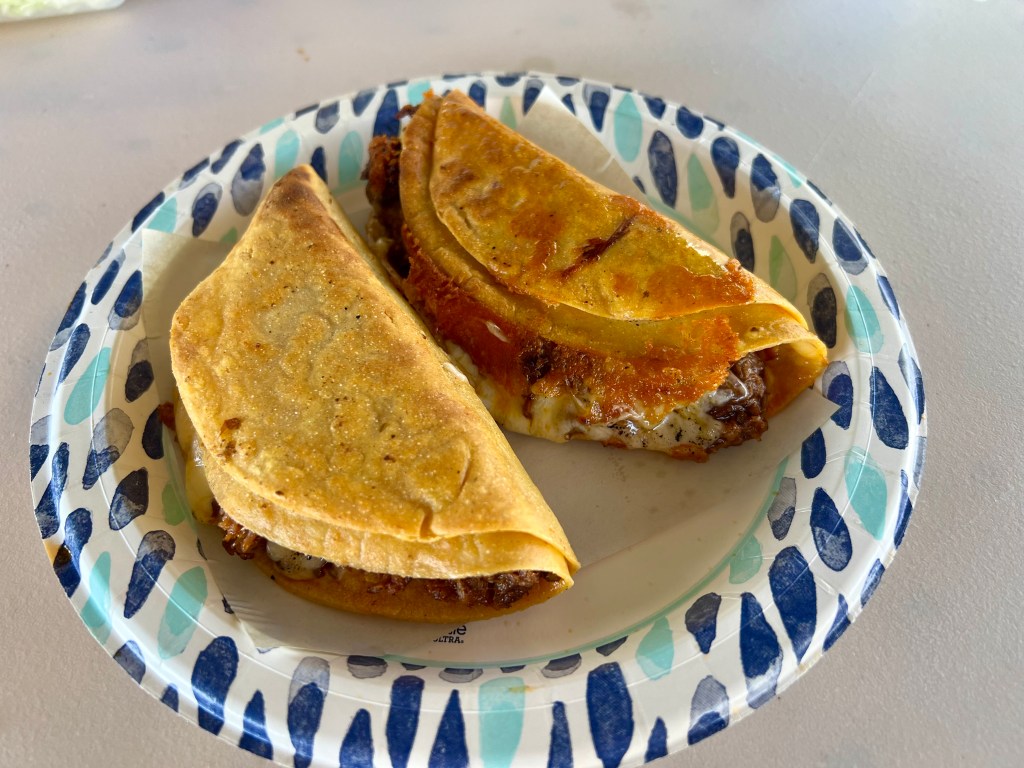
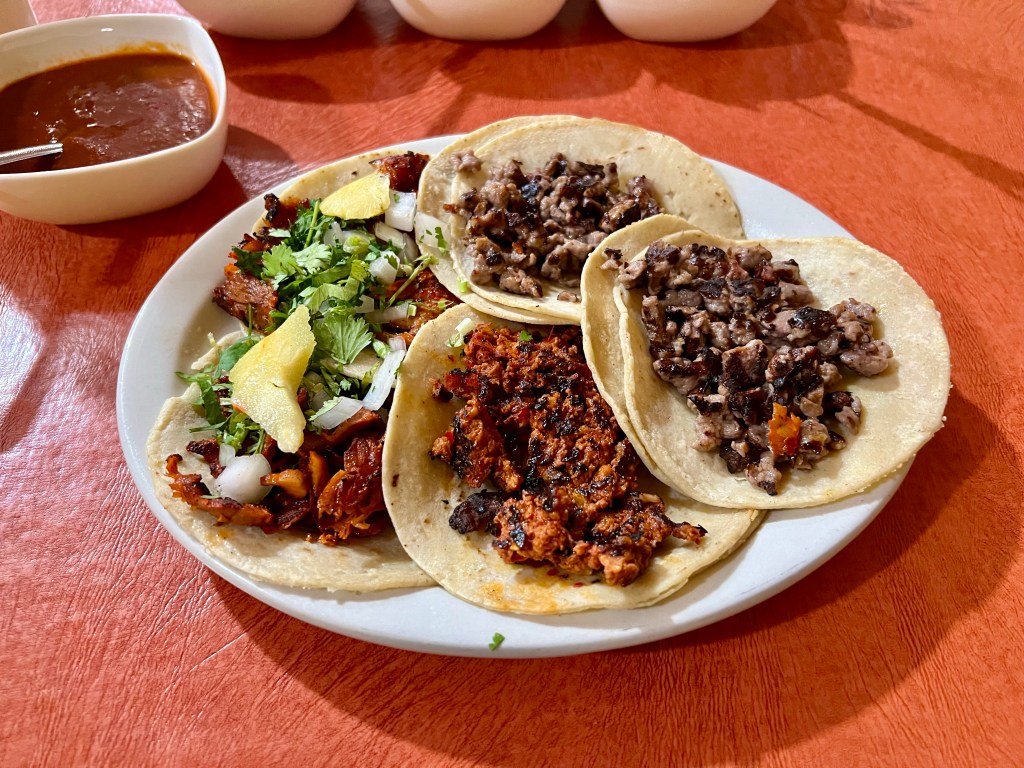
I took a shuttle back to the Cactus Hotel where my adventure began a week earlier. After a ~2 hour ride, with a quick stop in Los Barriles for cash for the driver, I was back in San José del Cabo. I hosed down the dirt from Hobbes before breaking the it down and repacking Hobbes for travel. I changed into fresh clothes I had left at the hotel, and headed up the street for some local food before heading to the airport. At the recommendation of the front desk clerk at the hotel I found delicious quesabirria tacos, consomme, and a half liter of coke.
A pair of quesabirria tacos from an unnamed street vendor.
A comically tiny car came to the hotel to take me to the airport – I’m not quite sure how we made the bike bag fit, but it did. I checked in to my flight a few hours early and headed to the lounge where I sat and drank – mostly ice water – for a few hours while waiting for the flight home.
I was still dehydrated.
By the time we reached Seattle I was tired, hungry, and ready to sleep in my own bed. When I got home, I wrestled the bike bag into the shed, took a long, hot shower, and fell asleep. Unpacking and reorganizing my gear will wait for another day…
Am I happy I went? Yes. Absolutely.
Am I sad that I quit before completing the loop? No, I’m OK with the outcome. This was the longest and most ambitious bikepacking trip I had ever undertaken. And I was doing it alone. Things didn’t work out as planned. I learned from the experience and will carry that forward to the next adventure.
I had another restless night with super strange, surreal dreams. Since I was meeting Lupe for a tour at 7:30 AM, I had an early alarm to allow me to have breakfast and get my stuff packed before he showed up.
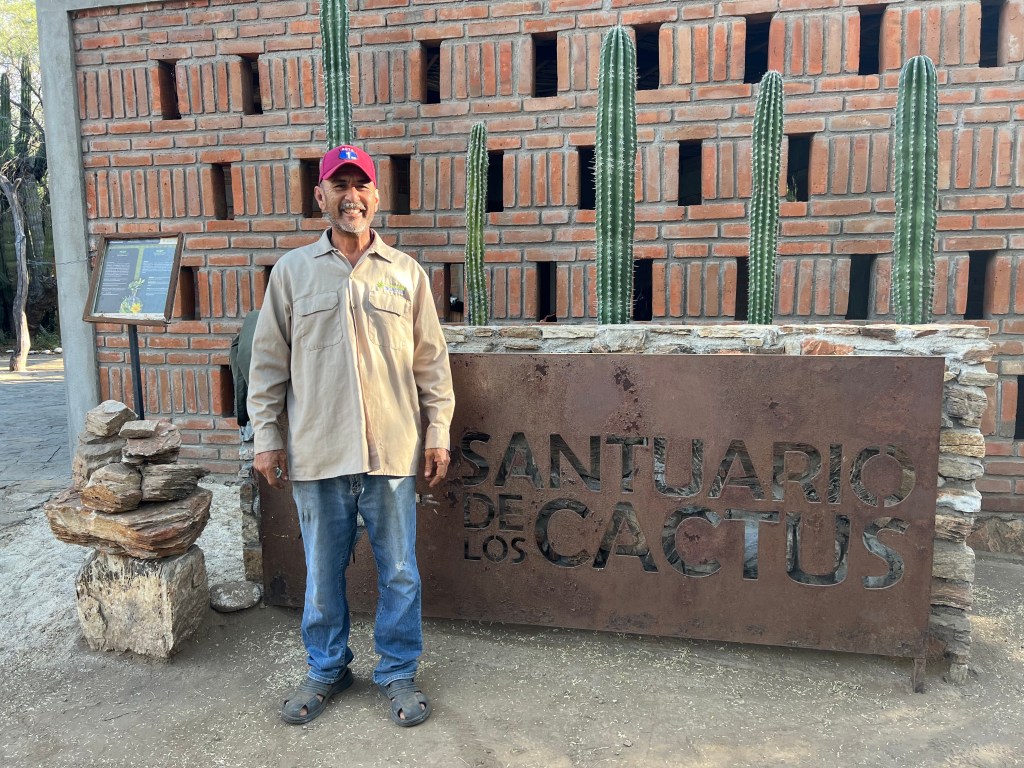
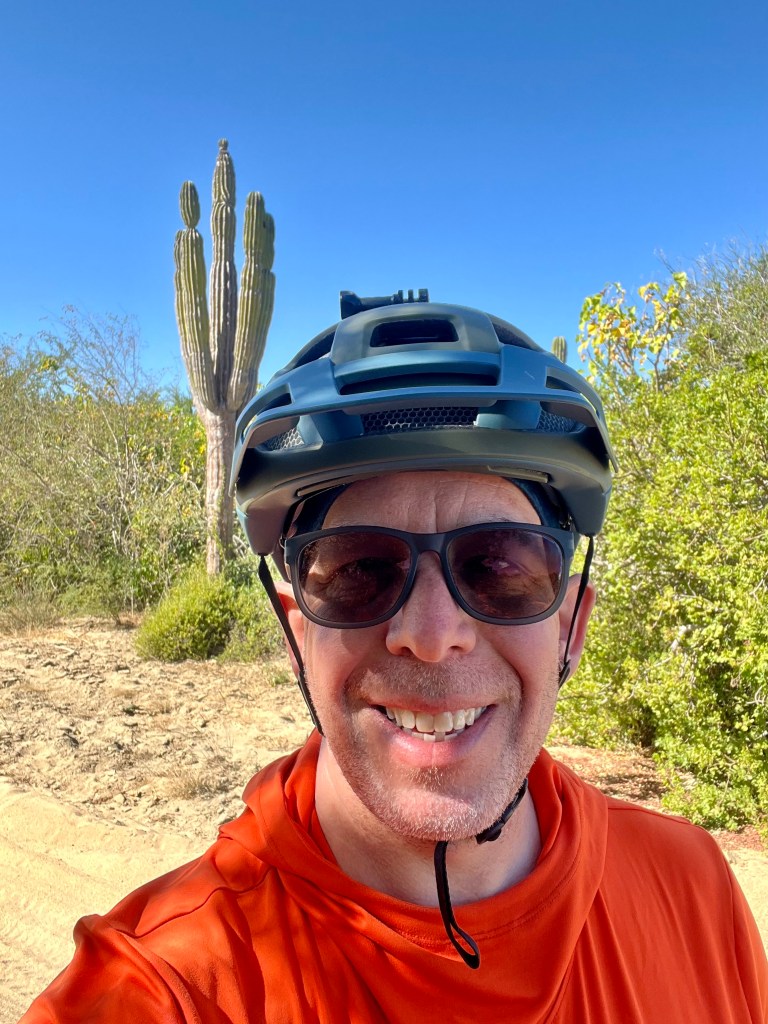
As promised Lupe showed up in the morning and gave me a very personal, in depth tour of the Santuario de los Cactus. Lupe shared with me that the sanctuary has been there for about 30 years. Six acres are protected with forty more acres surrounding the sanctuary waiting for fencing to protect it from local grazing animals. Lupe’s brother worked in the sanctuary for 28 years, Lupe has been working there since his brother’s death three years ago.
Lupe at the entrance to Santuario de los Cactus
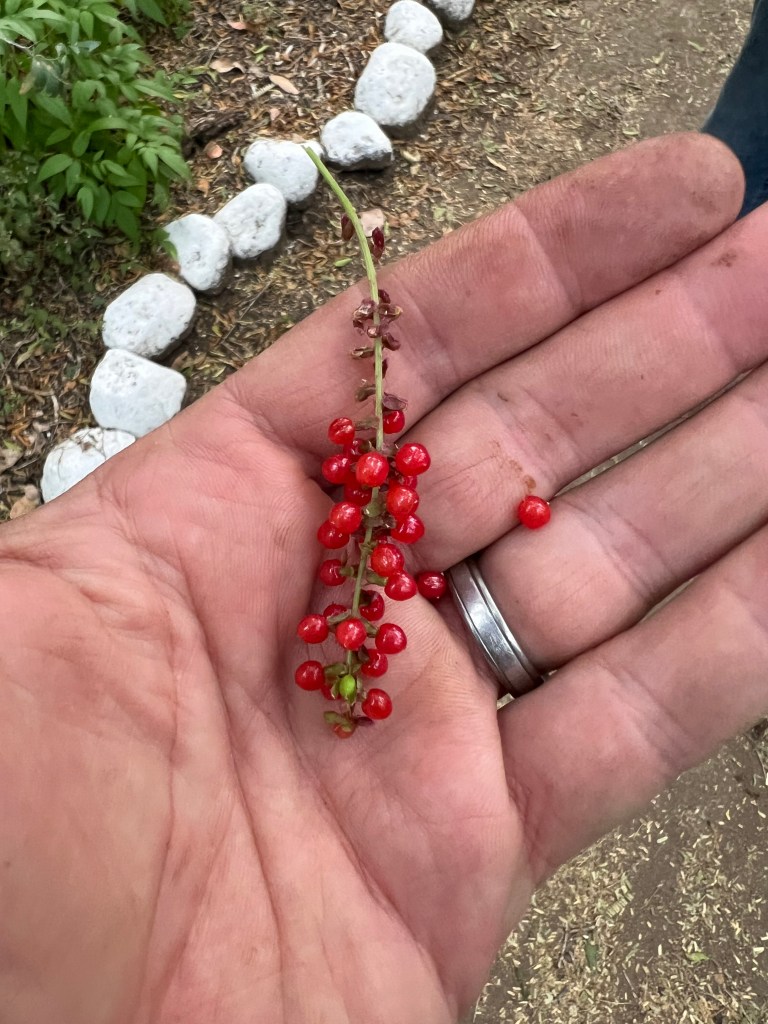
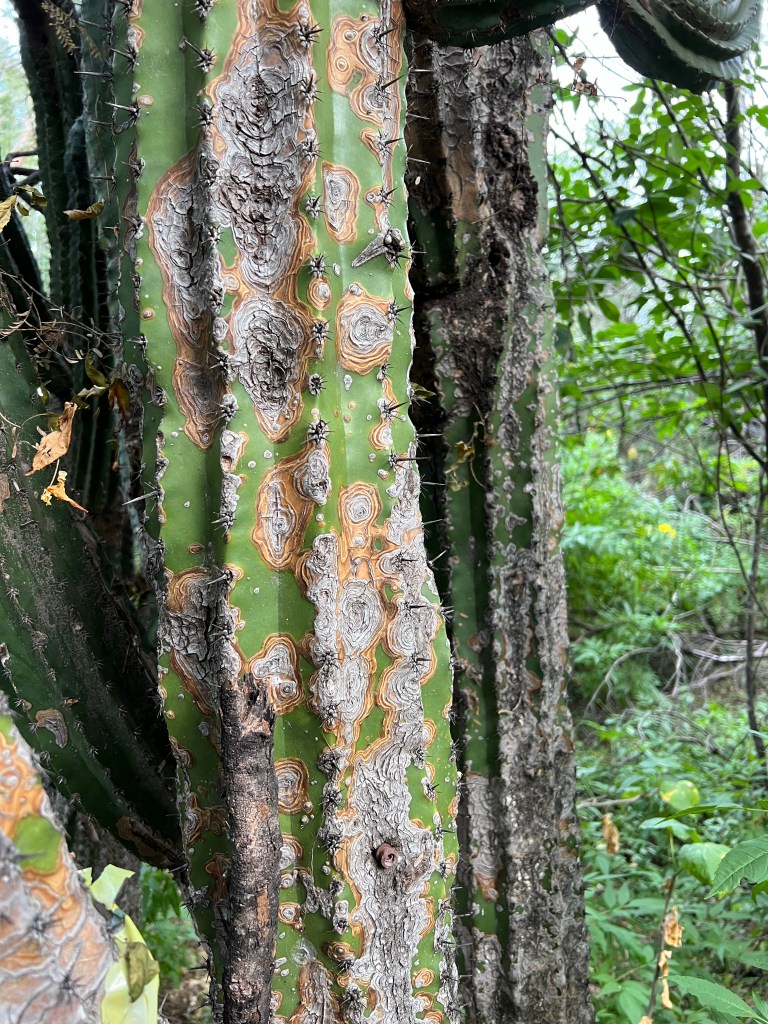
Lupe had a real connection to the sanctuary and its plants. He shared stories about the plants medicinal properties, pointed out spider eggs, local “cherries”, chiltepín chile plants, palo blanco trees with their incredibly straight trunks that the locals use to build structures, and all the different cacti. He showed me how the cacti “dance” when they’re shaken. I feel lucky to have spent time with Lupe and having him share his passion for the sanctuary with me. If you’re spending the night in El Rosario, make sure to ask in town for Lupe.
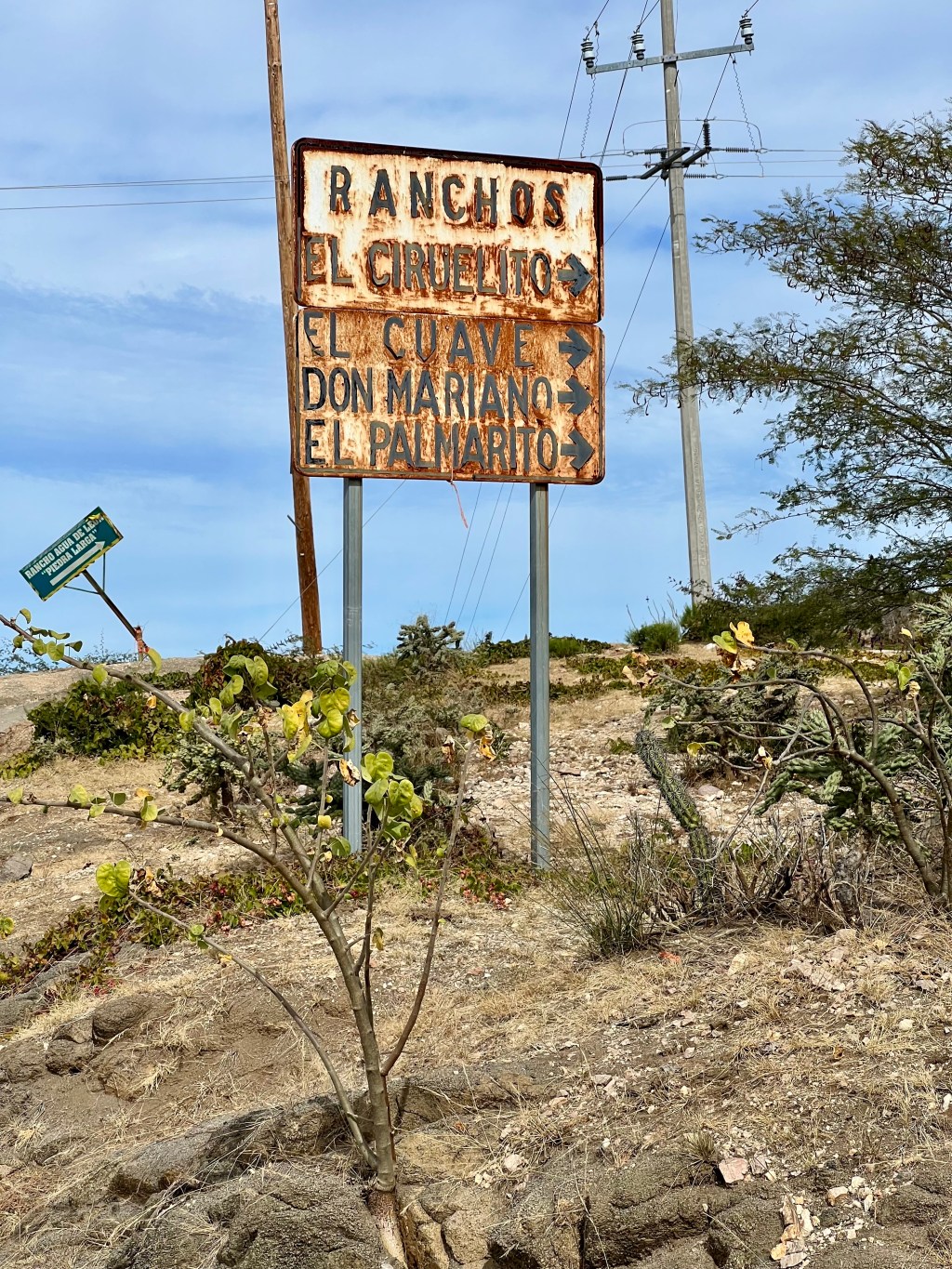
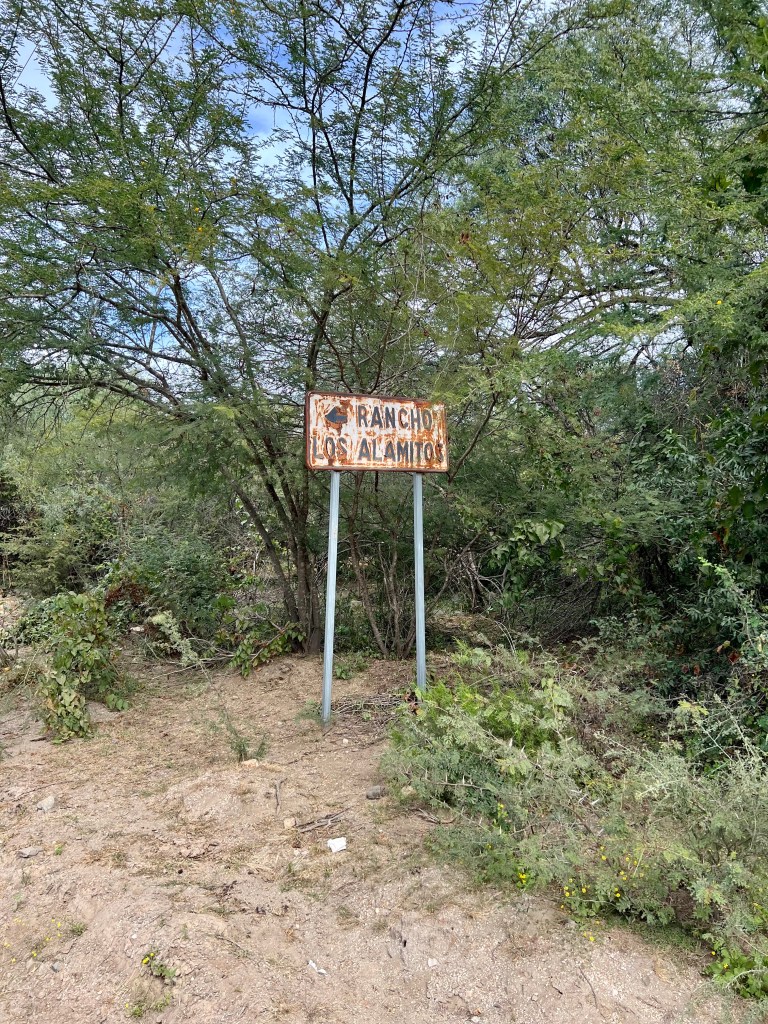
Departing the sanctuary, it was an easy dirt road for about 3 miles, followed by a 2 lane highway for another 7 miles before turning off on another dirt road. I knew the remainder of the route was going to be empty. Lupe told me about one store that I would encounter 5 miles down the road. There was a sign for Rancho Los Brasiles restaurant at the highway turn off. I stopped two guys in a compact car as they turned down the road and asked about restaurants and they enthusiastically told me to go to Rancho Los Brasiles before taking off down the dirt road.
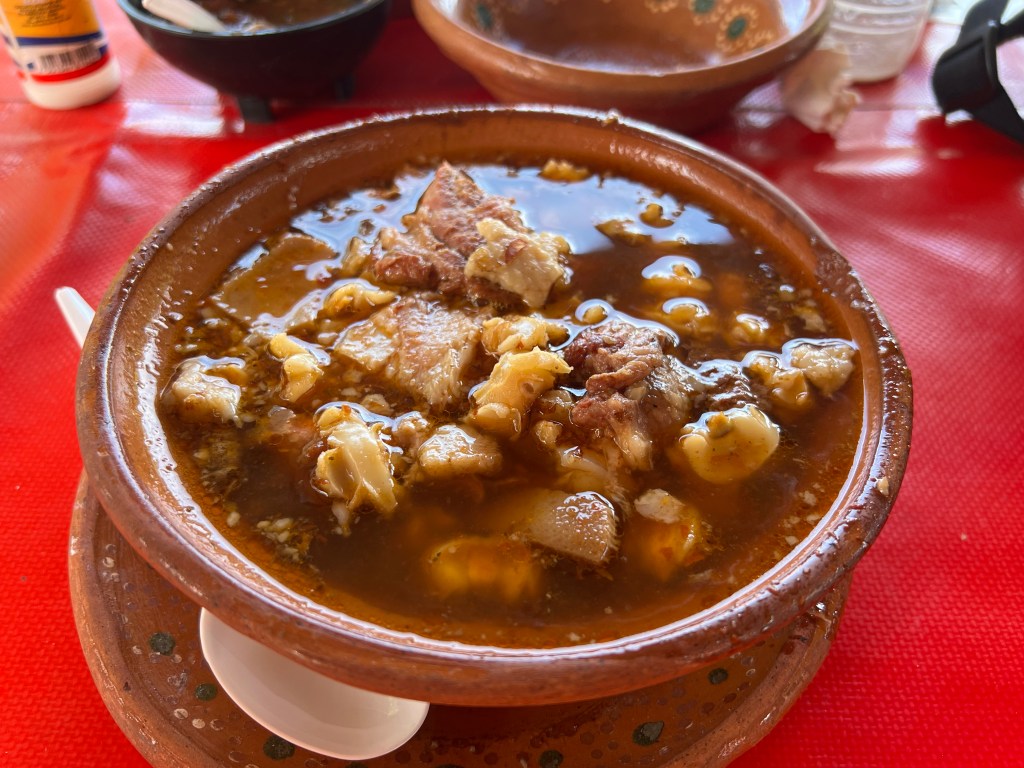
Posole at Rancho Los Brasiles
A little while later, I rolled into Rancho Los Brasiles and ran into my friends in the compact car. They bought food to go and were on their way out. The driver gave me a fist bump when he saw me and let me know he was glad I found the restaurant. I sat down at a table in the shade, ordered some pozole, horchata, and a liter of water, and had a leisurely lunch. I struggled to eat all the food – again – before heading back to the main road for the mostly deserted stretch between through ranch lands on the way to La Ventana. The road was very quiet, I only saw a few cars. One SUV slowed down to see if I was OK and knew where I was going. Even though I was still not eating sufficiently, I felt OK and started the climb to Los Divisaderos, a ranch near the top of the climb.
The climb was long and exposed, with a few steep pitches. My planned route took me off the main road to Iglesia San Blas, but seeing the deep sand between the main road and the church, I skipped the church rather than fight unridable sand. I wasn’t aware what I was going to face a short time later.
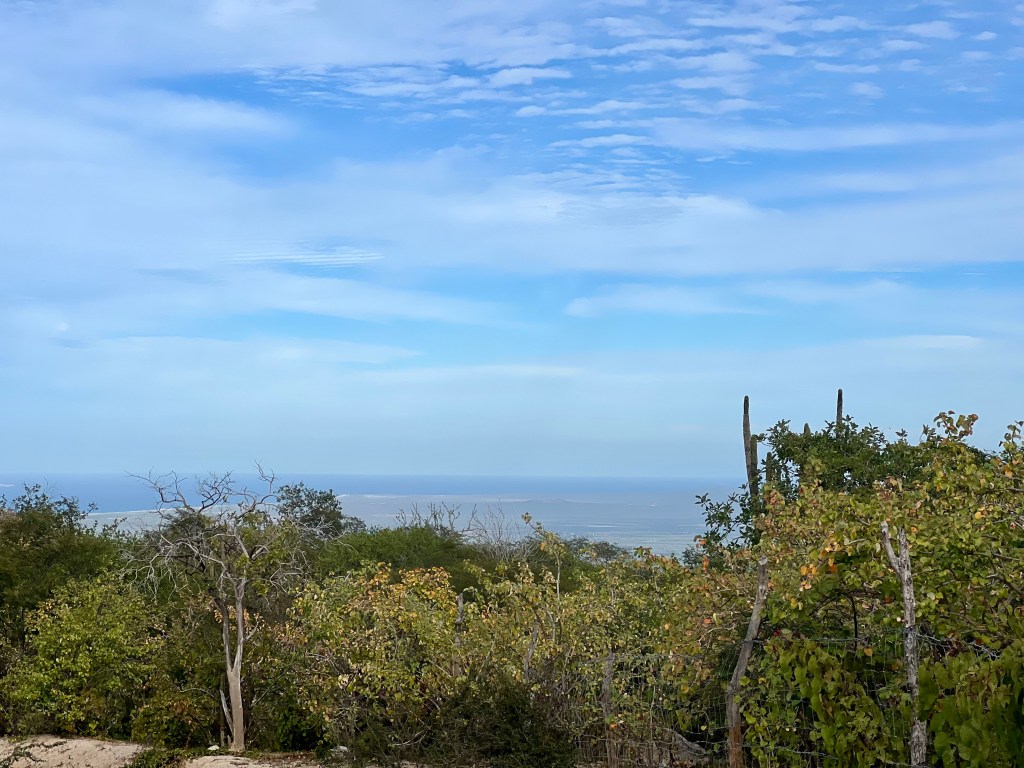
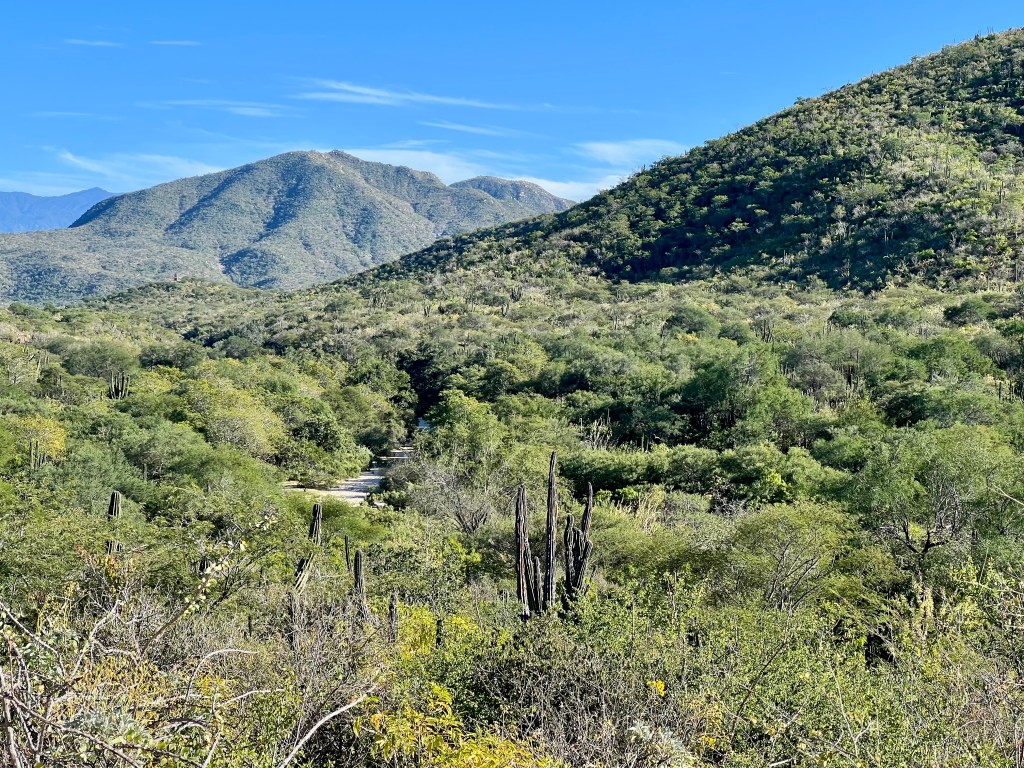
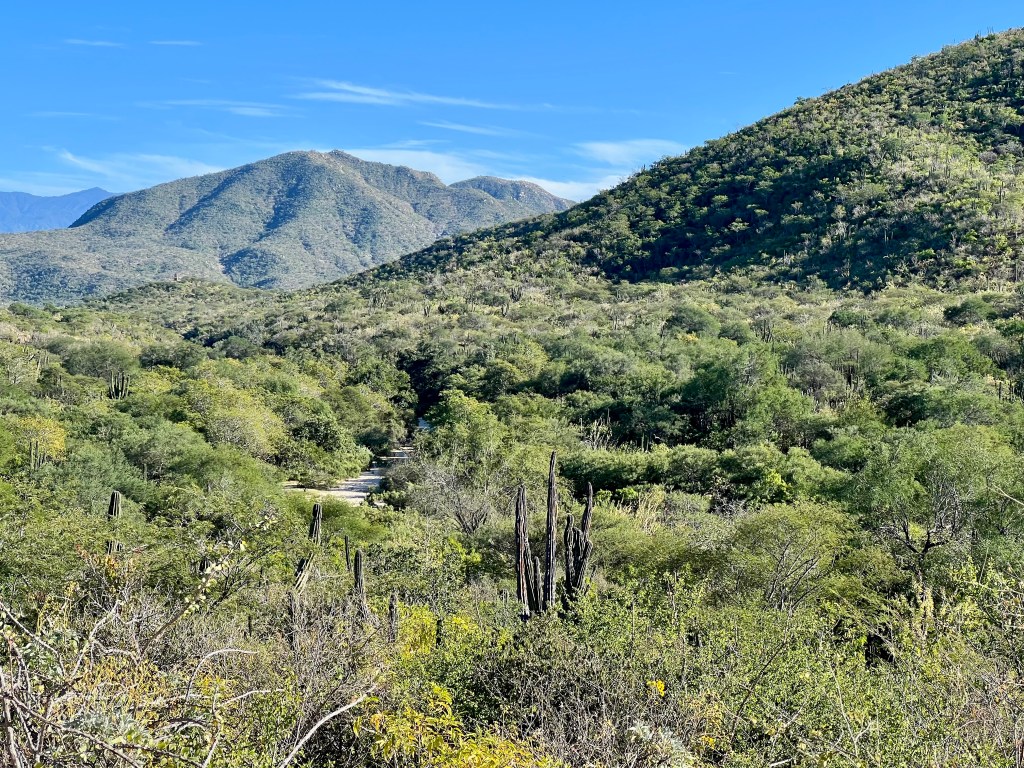
Passing through Rancho los Divisaderos I was chased by a handful of dogs. A few squirts from my water bottle sent them away, while I continued pedaling up the hill. Eventually, I crested the hill. Hot and tired, I was looking forward to the next few downhill miles to cool off, and enjoy a fun descent all the way down to the Sea of Cortez. I came around a bend and could see the lowlands around Los Planes and the sea beyond.
Around the same time, I received a handful of texts. I was once again in an area with cellular coverage. I had a quick chat with my wife before Hobbes and I set off downhill with visions of tacos and beer filling my stomach in a few short hours…
Minutes later, everything changed.
Looking NE toward Los Planes and the coast.
Riding down a non-technical section of the road there were long stretches where the road was divided lengthwise by channels formed from water runoff. The channels run roughly parallel with the road, requiring me to maneuver along the channels, riding the high, uneroded road bed as much as possible. A momentary loss of focus and I watched as the front wheel dropped into one of the channels, caught the edge of the channel on the right side, and threw me off the bike.
Physically, I was in OK shape. In the crash, I came off to the right, skinning my knee. My right elbow and shoulder were sore from landing on outstretched hands. I pulled out my first aid kit, bandaged up my knee, and checked out Hobbes. I’m not quite sure how this happened, but the crash bent the arm which my cycling computer and GoPro mount to. Not a big deal. Everything else seemed fine at the moment.
Except for me.
Back on the bike, heading down the hill, I was feeling pretty low. Accidents happen, yet I was second guessing everything I had done leading up to that moment. My tiredness contributed to my loss of focus and the crash. I began to consider what would have happened if the crash was worse? I hadn’t seen any humans in an hour or so, and that was on the other side of the pass I had just crossed. My mobile phone had service and my satellite messenger was available in case I really needed help, though it could be hours before help arrived. Instead of focusing on the fact that my bike and I were both intact and able to continue onward I started down the path of worst-first thinking. This is a helpful skill at my day job, but not so helpful at this moment in time.
Then I started mentally working through the calendar and the remainder of the ride I had planned. Could I get to La Ventana, and stay an extra rest day? If I did, I’d have to go three days straight to get back down the coast to San José del Cabo. What if I try to take an easier route tomorrow as I head toward the coast? I was thankful that I had studied the route, I had a reasonable mental map of my options for the next few days and could figure out a plan.
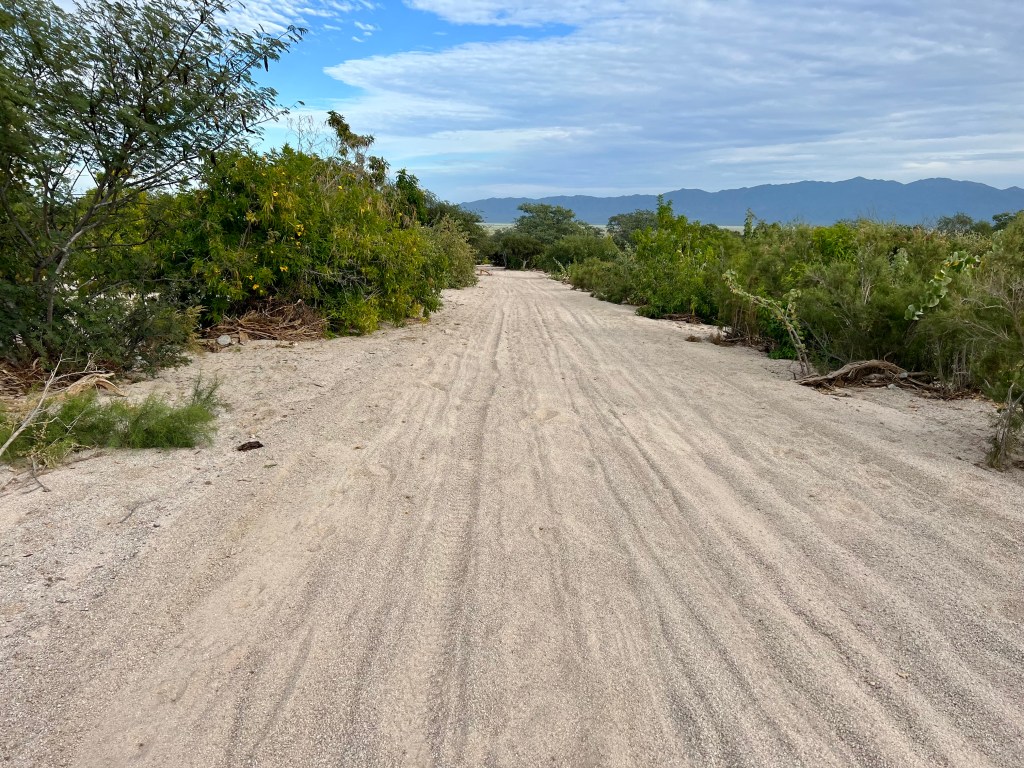
About two miles past where I crashed I ran into sand. Deep, miserable sand. The next five or so miles alternated between barely rideable sand and absolutely unrideable, get off and push sand. Over the next 90 minutes I would alternate between riding, pushing, and loudly cursing at the damned sand. At the same time, both brakes began dragging and squealing with each revolution of the tires.
Miles of sand.
The sand broke me both physically and mentally. During this push I decided my Cape Loop ride was done. I could choose to be stubborn and try to continue onward at the risk of hurting myself or finding myself stuck in a more difficult position. The better, wiser choice was to get myself to town and figure out way to get back home a few days early.
First, I have to get to the highway and then ride into town, chasing the fading light and my waning energy levels.
I made it to the intersection of the highway and the road to La Ventana. Contemplating my options, I stuck my thumb out for a ride. Within 2 minutes, a truck with Oregon plates turns on to the road to La Ventana and pulls over. Vince steps out and asks me how he can help. I texted him the GPS coordinates of my AirBNB and he helped me put Hobbes in the back of his truck. I hopped in the back with Hobbes and rode the last few miles into town with Vince. He dropped me off at the AirBnB and let me know he would text me information on a recommend a bike shop in town or, if I wanted, a transportation company to help me get back to the airport in San Jose del Cabo.
Thanks, Vince, your generosity reminded me that there are good people in the world who do things out of kindness and care for others. (Vince texted me the next morning and again a few days later to make sure I got home ok. We need more Vinces in the world.)
Inside the AirBNB I took a shower, switched into clean(er) clothes, and walked a few blocks for dinner and a beer. I called Delta and they changed my return flight to the next day (at no charge! Thanks, CS agent Stephanie!). Vince hooked me up with a shuttle driver for transportation to the hotel in the the morning.
I repacked my gear for tomorrow’s ride back to San José del Cabo and headed to bed.
Today, I was up and out of the door early, riding by around 7:30 AM. As soon as I left my AirBNB, I noticed just how windy it was. The next few hours were spent fighting a steady 15+ MPH headwind riding along the highway toward La Paz. The noise from cars and trucks, combined with the constant wind noise was difficult to block out. AirPods Pro 2 can only do so much to reduce the outside sounds.
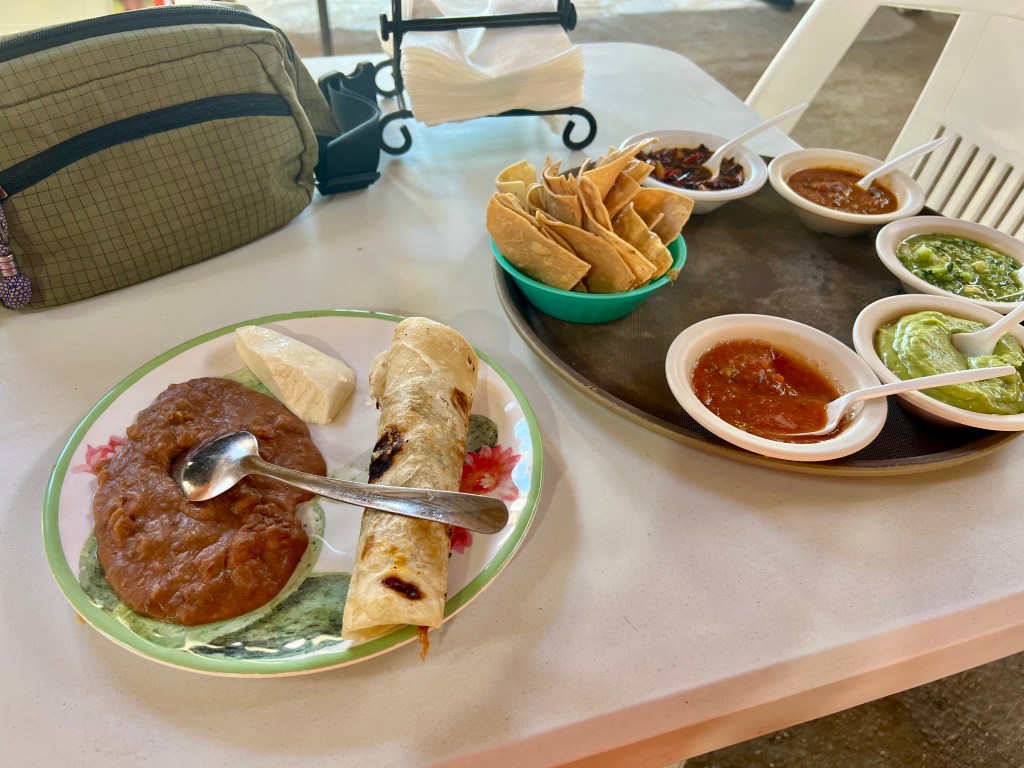
The highlight of 20 miles along the highway was finding myself at Lonchería la Garita. I happened upon the restaurant right around the time I was considering a lunch break, so I dropped in for a machaca burrito, some fresh pressed cheese, refried beans, tortilla chips, a large Fanta orange soda, and a bottle of electrolyte drink. After a welcome break from the highway, I hopped back on Hobbes for 6 more miles of pavement before turning east on a dirt road back into the mountains.
Lunch at la Garita.
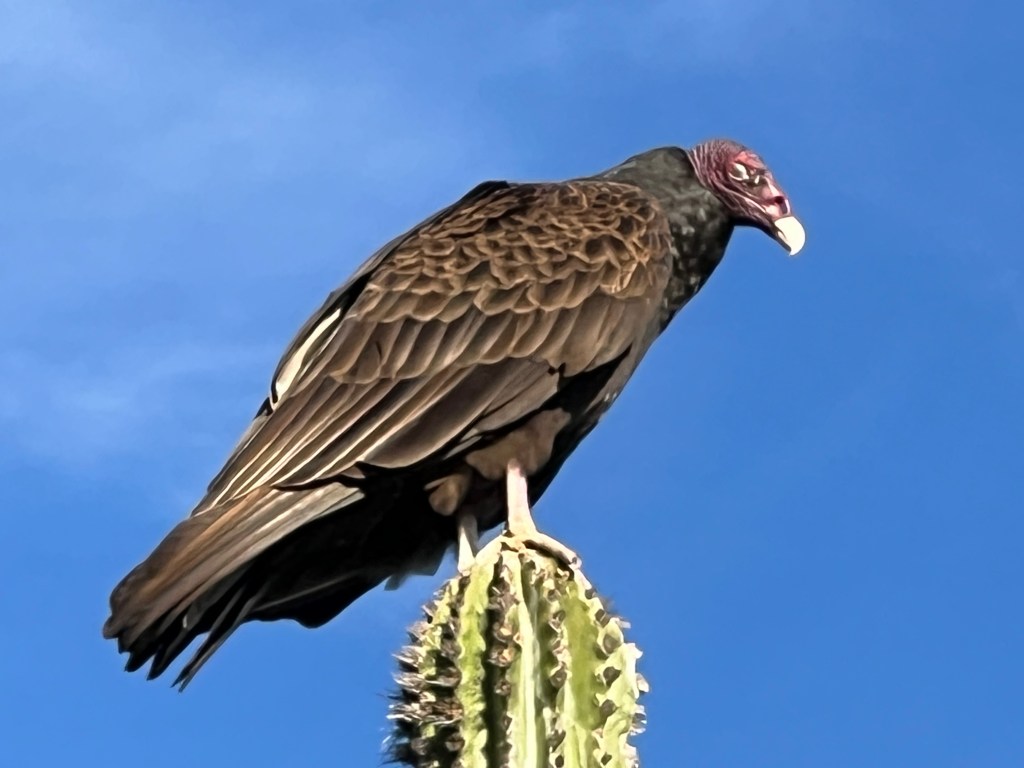
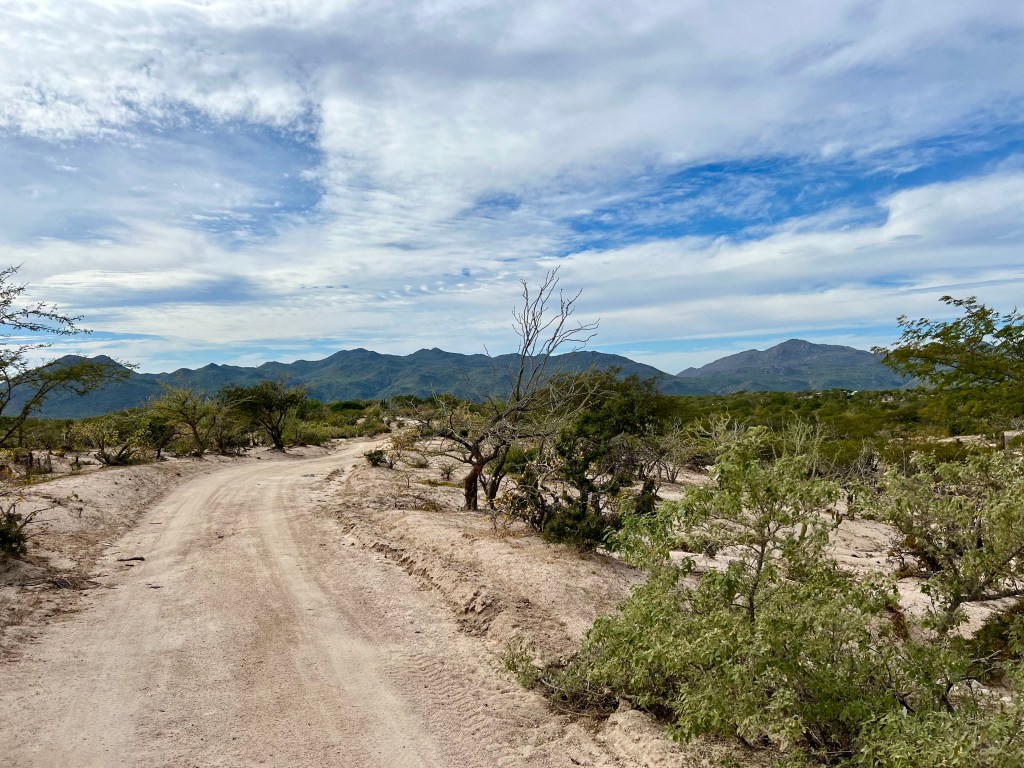
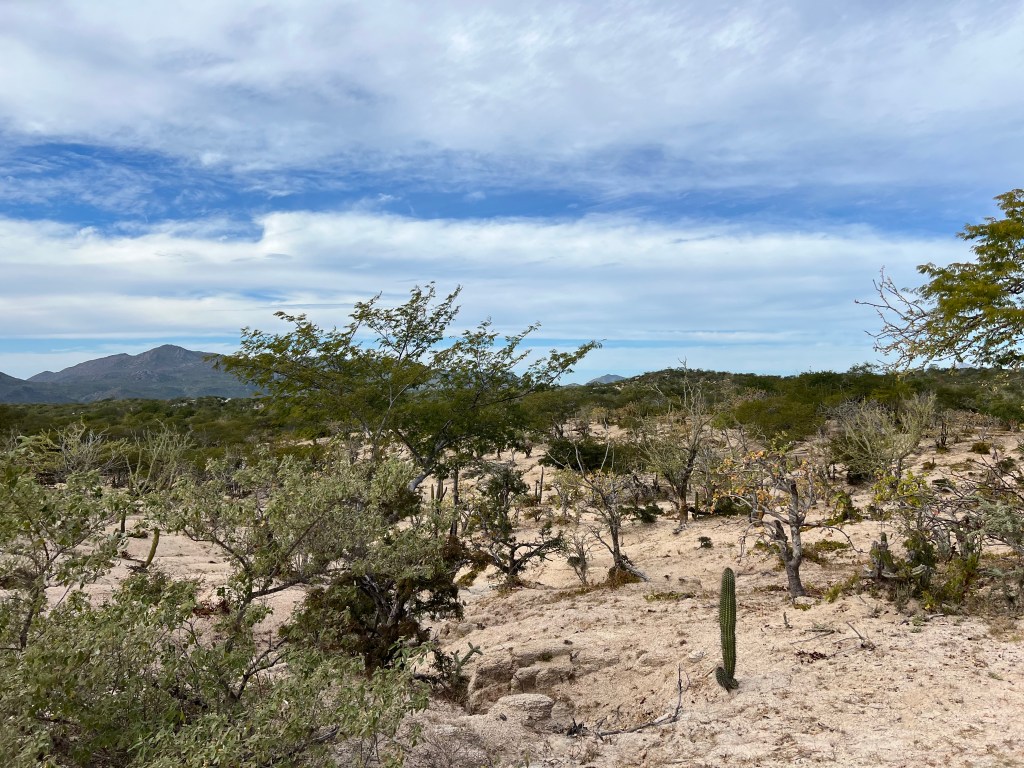
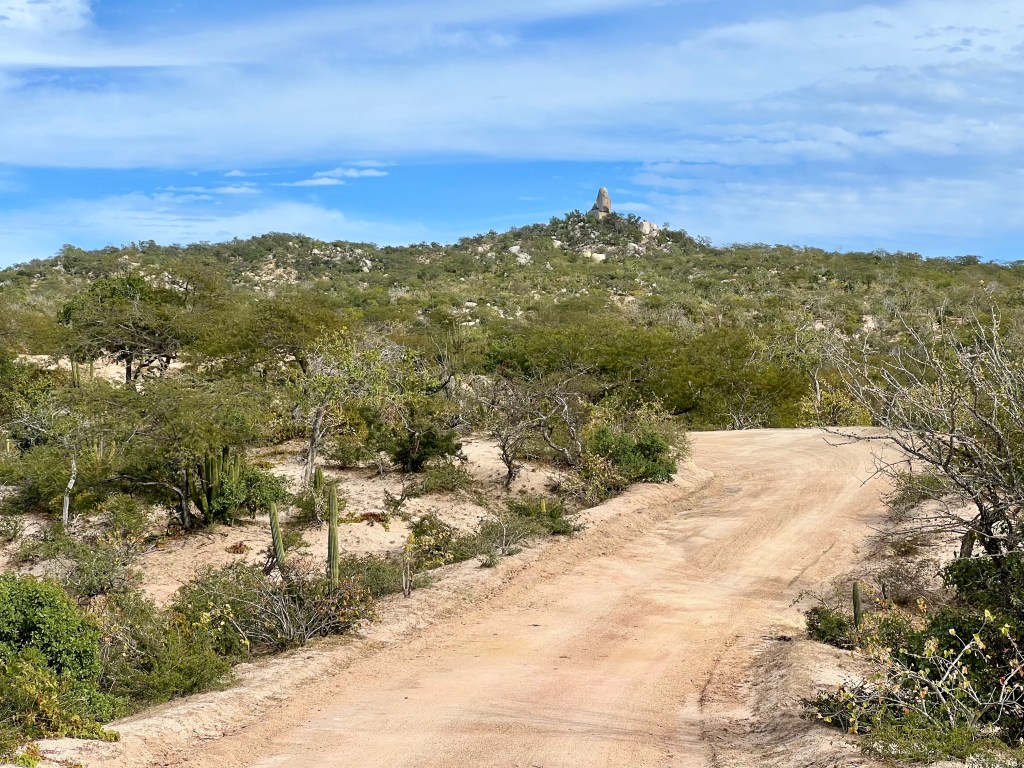
The next 8 miles was a mix of hard packed dirt and loose, rideable sand through forests of mesquite and cacti with roadrunners and doves all around. There were ranches on both sides of the road which means lots of cattle poop and the occasional cattle grazing along the roadside. I passed directly through one ranch, passing through a small herd of cattle and right past the ranch house. Eventually I reached the north end of el Valle Perdido, the Lost Valley, where I turned north to ride into el Rosario.
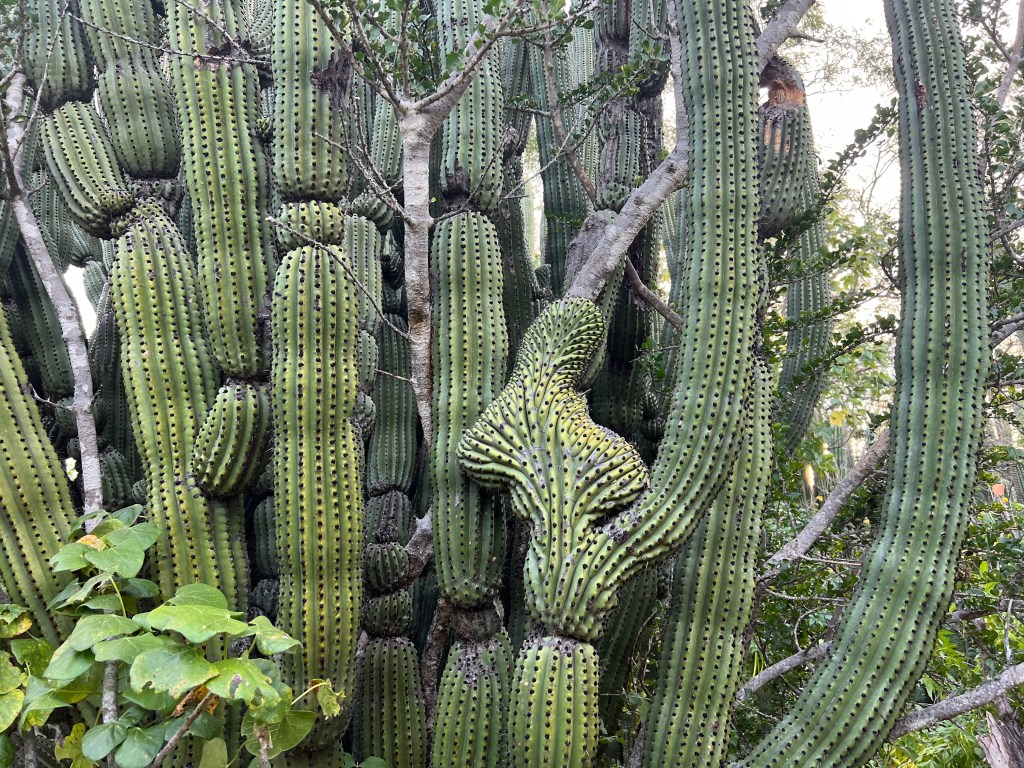
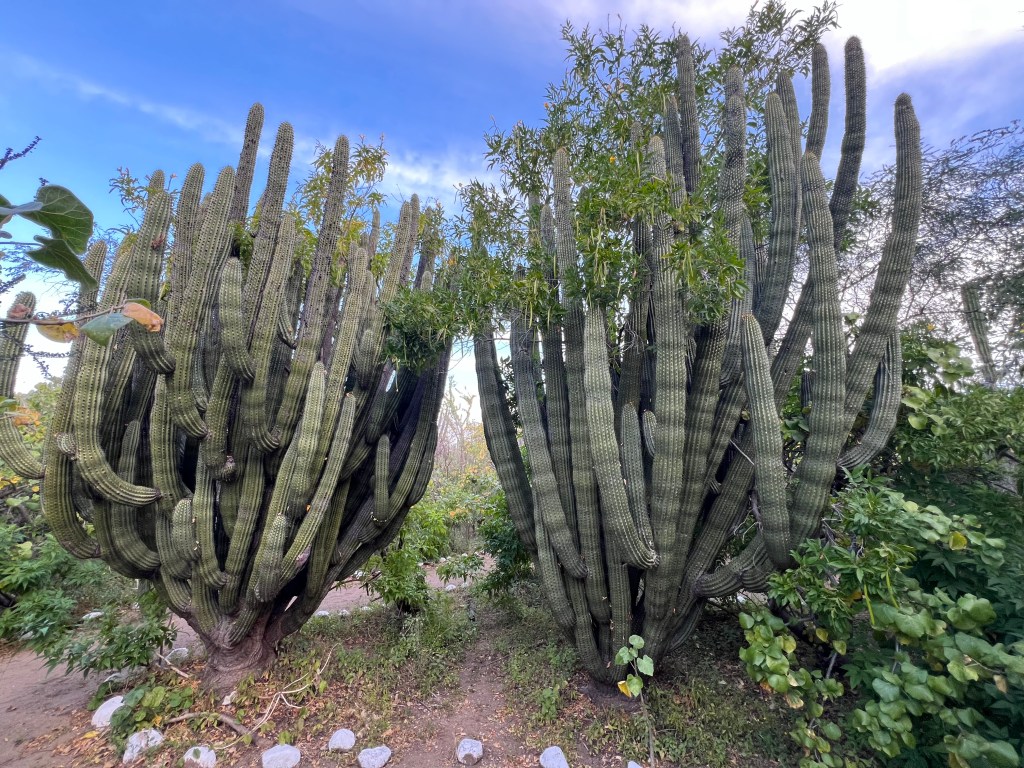
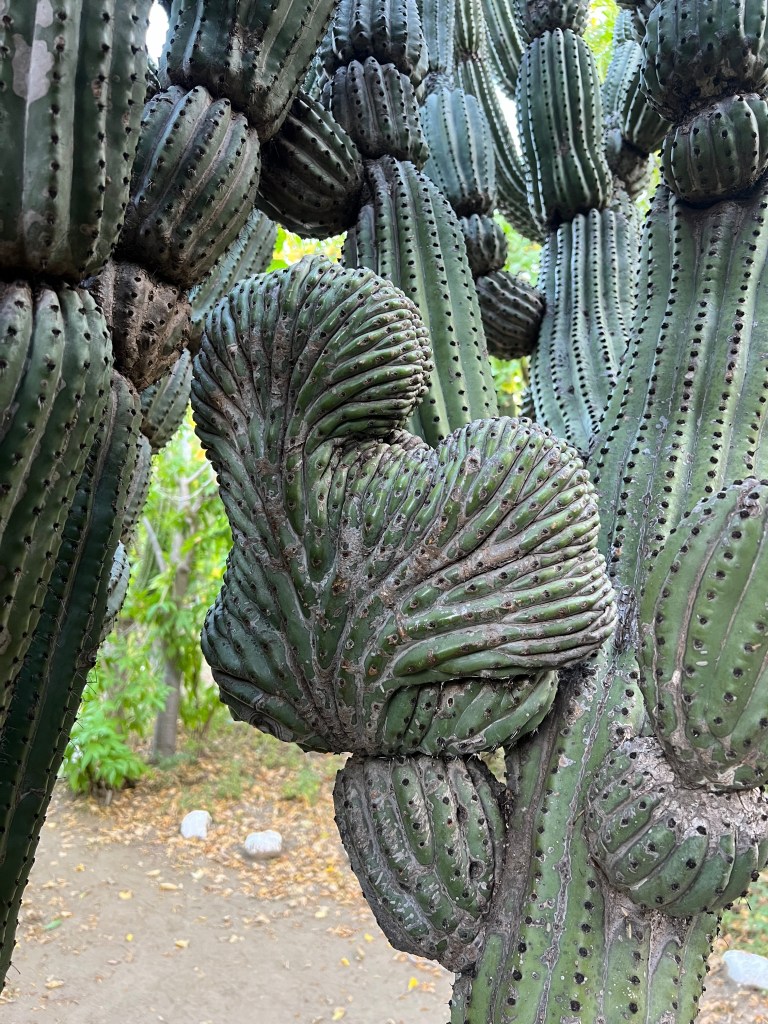
One of the very large cactus along the route.
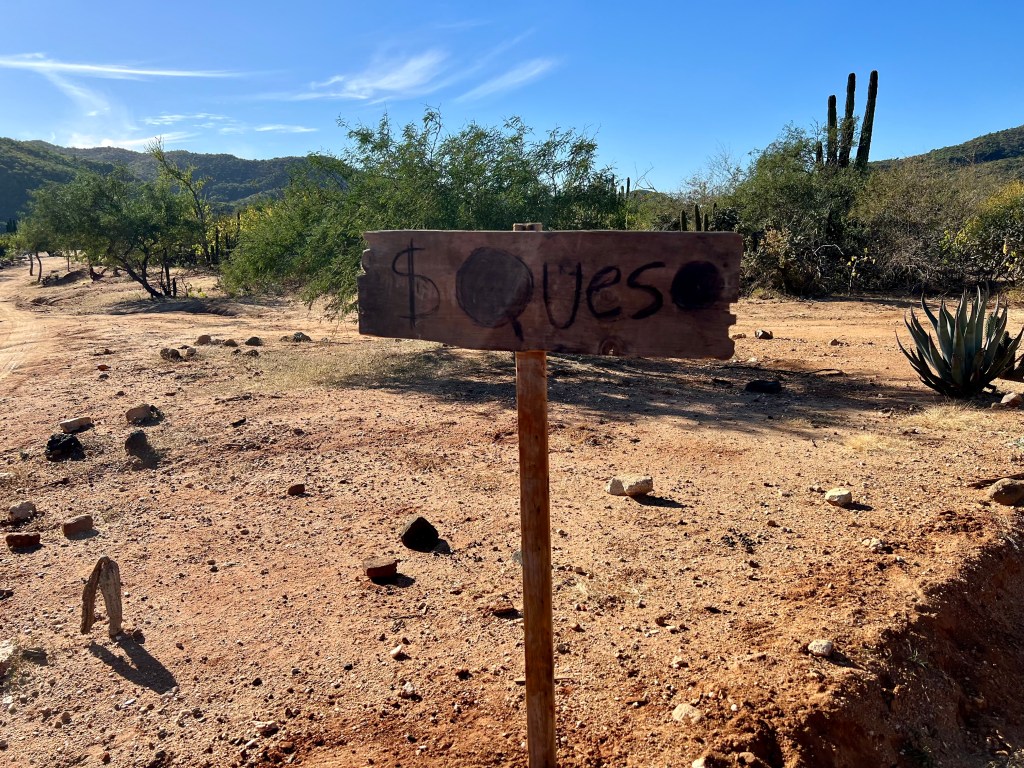
In el Rosario I stopped in at the local tienda for four liters of water and two beers. I rode two minutes down the road to el Santuario de los Cactus and found it gated. Back to the tienda, the owners let me know they had called Lupe and that he would meet me at the sanctuary. I could let myself in – the gate was to keep the cattle out, not people.
Looking south into el Valle Perdido
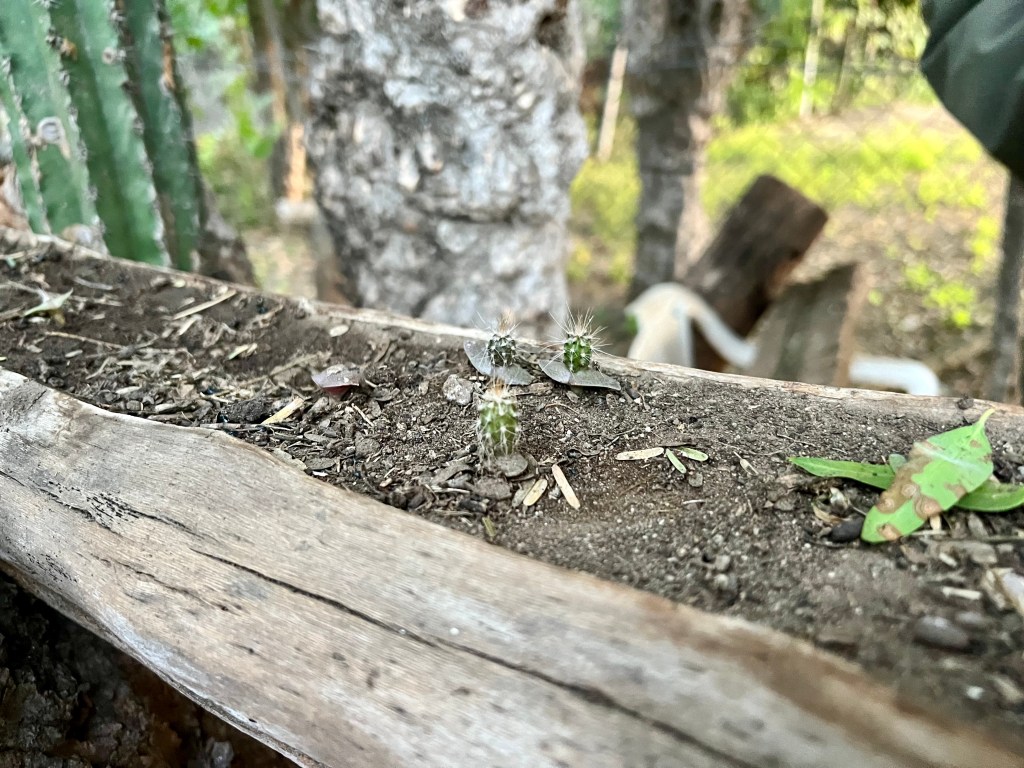
Back to the sanctuary, I let myself in and began to set up my tent under the future entrance building to stay out of the wind. Eventually a car drives up and I meet Lupe for the first time. Lupe is the caretaker of the sanctuary, a job he’s been doing for about 3 years. His brother was the caretaker before him for 28 years! Lupe shows me around, sets me up with a nice fire, a grate to cook over, and a chair to sit in. He proudly showed off the baby cacti he planted. I had no idea that cacti sprout with a pair of cotyledons! Lupe left with a promise to return at 7:30 AM for a personal tour of the sanctuary.
I made a quick dinner which I ate by the fire. I consumed at least a liter of water and a pair of cans of Tecate while reading by the fire. Tired, I put out the fire, climbed into my tent, and listened to an audiobook until I fell asleep.
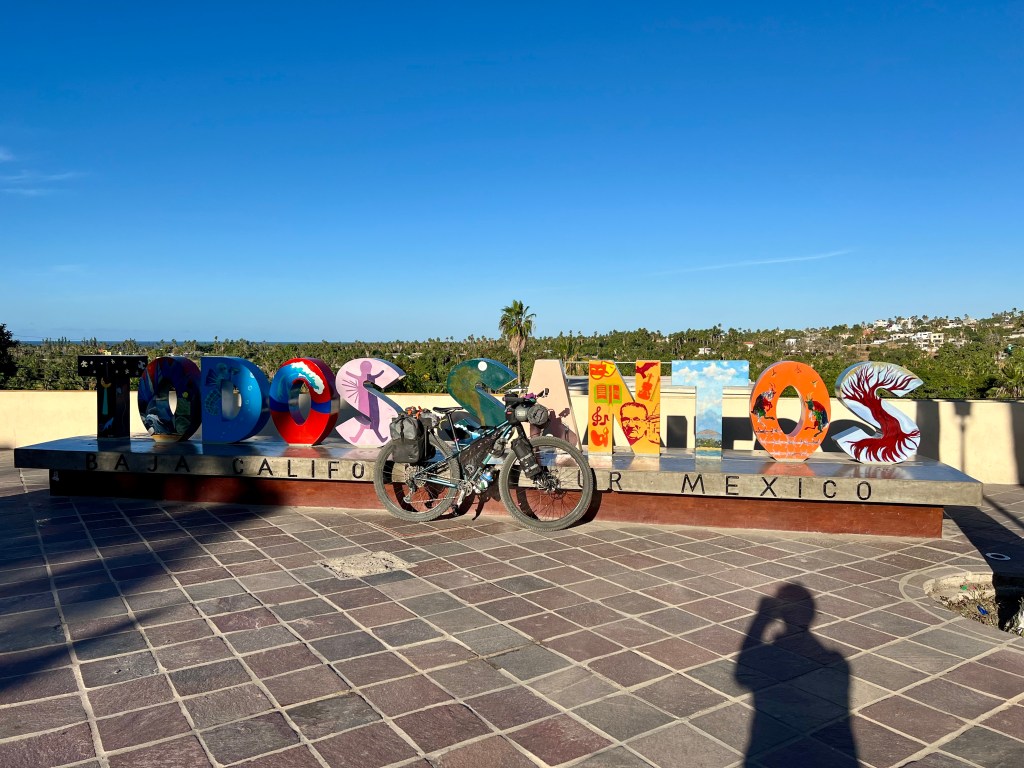
After a fitful night’s sleep, I decided to stay in Todos Santos for a rest day. I ate a lazy breakfast and then dropped by the bike shop in town. One of the guys at the shop gave me good information on the next section of the route. I extended my AirBNB stay for another night, which gave me the opportunity to nap, lay in bed, read, and stay out of the sun. Which I did for about six hours – three before lunch, three after.
Tomorrow I plan to ride to El Rosario and Santuario de los Cactus. Taking the advice of a previous rider, I decided to take the highway (ugh) out of town to make the day easier. I’m still feeling tired from yesterday’s effort. The new route follows the highway for about 20 miles, before turning on to a local ranch road and meeting up with the official route in Valle Perdido. I restocked my food, repacked the bike, and went to bed early to be prepared for tomorrow’s ride.
After a quick breakfast at the hotel, I headed off to the mountains. But first, I had to navigate about 8 miles through the San José del Cabo suburbs and along Mexíco 1, the highway between San José del Cabo and La Paz, to the north. Thankfully, there’s a dirt road running parallel to the highway for much of the route, so I was able to minimize my time on the road itself. (Note: the official route has recently been reported to be closing/closed. I’m not sad that I missed multiple miles of deep, unrideable sand.)
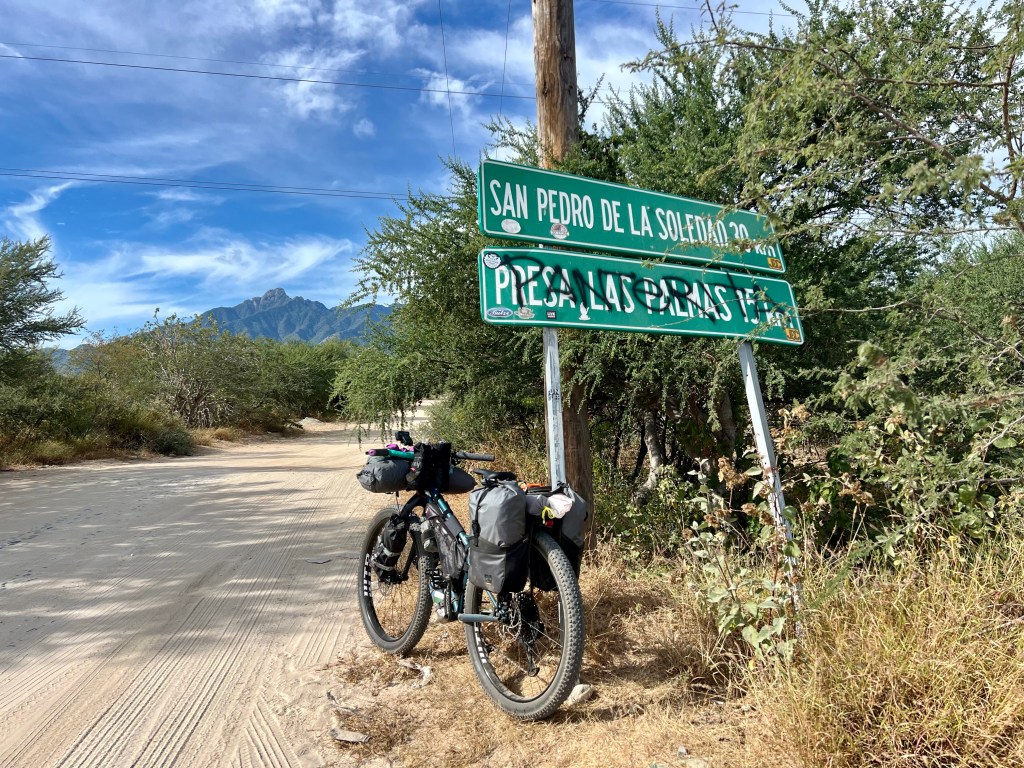
Adventure begins here, at the turn off from MEX1 on to the Camino Las Naranjas
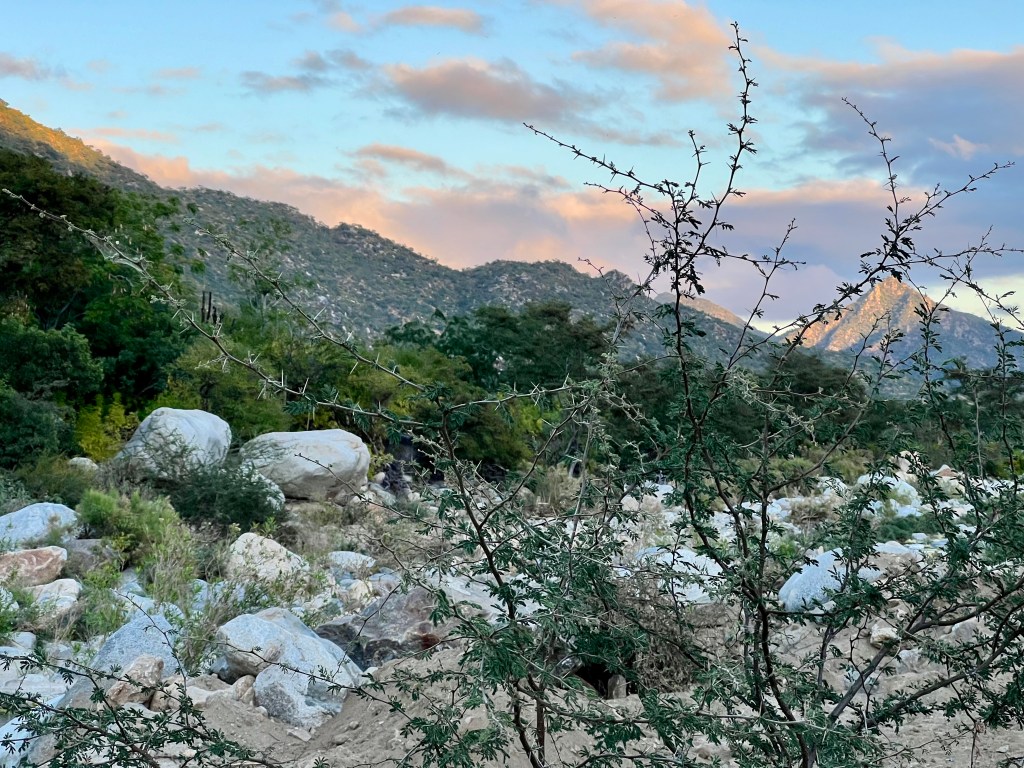
From here, the route starts a steady uphill climb, crossing arroyos that cut through the mountainous landscape. The road has a fair bit of traffic, mostly ranchers (I assume), but I did see a few families out exploring and playing in the cool water of the arroyos.
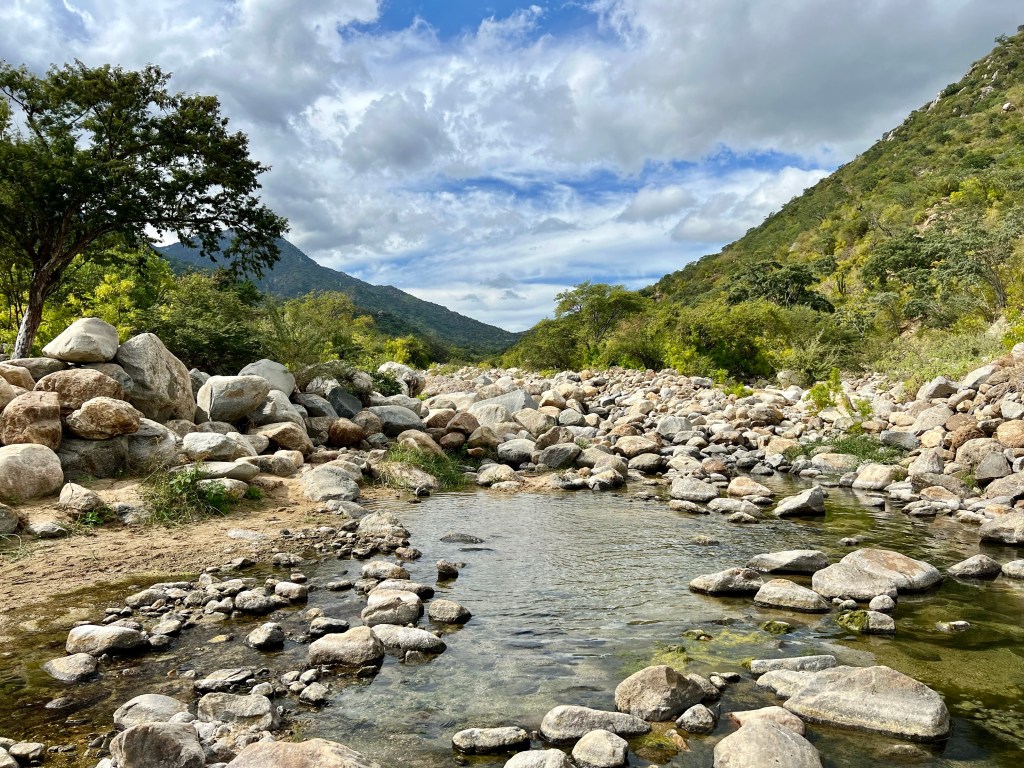
I stopped at the first arroyo I came across for a quick break. I spoke to a local family out enjoying the day, they let me know that many of the arroyos have active streams now because of the late fall hurricane that hit this area. I headed off up the road, only to be passed by their car a few minutes later. We met again at the second arroyo. They stopped to play and make lunch, while I stopped to eat my cold soaked couscous before continuing onward.
The first arroyo.
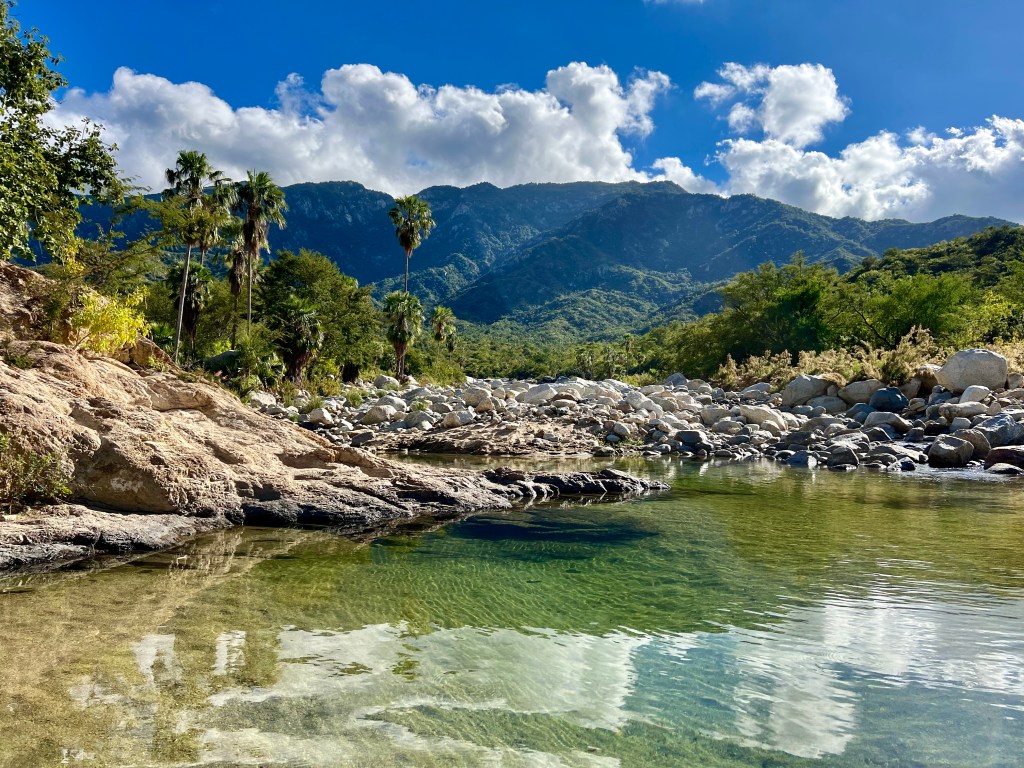
Continuing a steady climb into the Sierra de la Laguna I finally reached a downhill stretch where I came across the Buddhist retreat, Tsegyalgar West. This community owns a significant amount of land in the area, signs on both sides of the road notified visitors that the area is private property for miles. About a mile after the entrance to Tsegyalgar West, I came across a beautiful arroyo with a fast flowing stream. Sometimes called, “las pozas budistas,” or, “The Buddhist Pools,” I took the opportunity to cool off in the water and refill my water supply for the evening to come.
Las pozas budistas
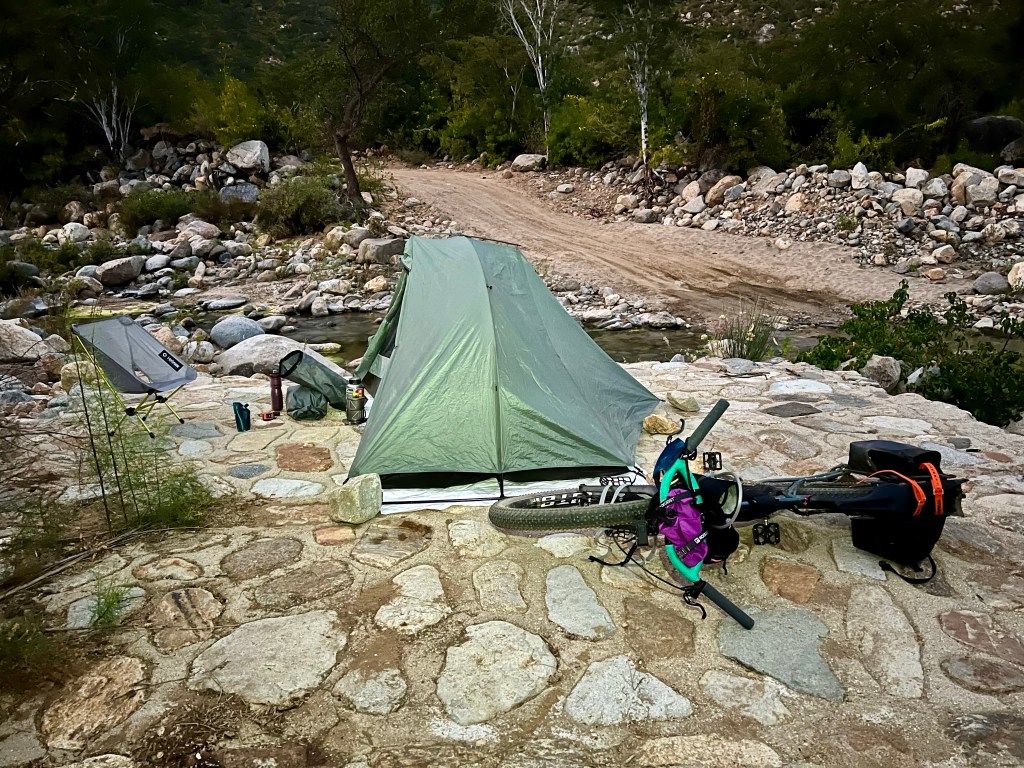
I continued on another mile or so before finding a great campsite next to another arroyo filled with flowing water. A steer laid down on the other side of the arroyo and watched me set up camp for the night. Once the sun set, about 5:45 PM, the clouds rolled in and darkness settled over everything. The heat of the day quickly faded and I went to bed before 8:30 PM.
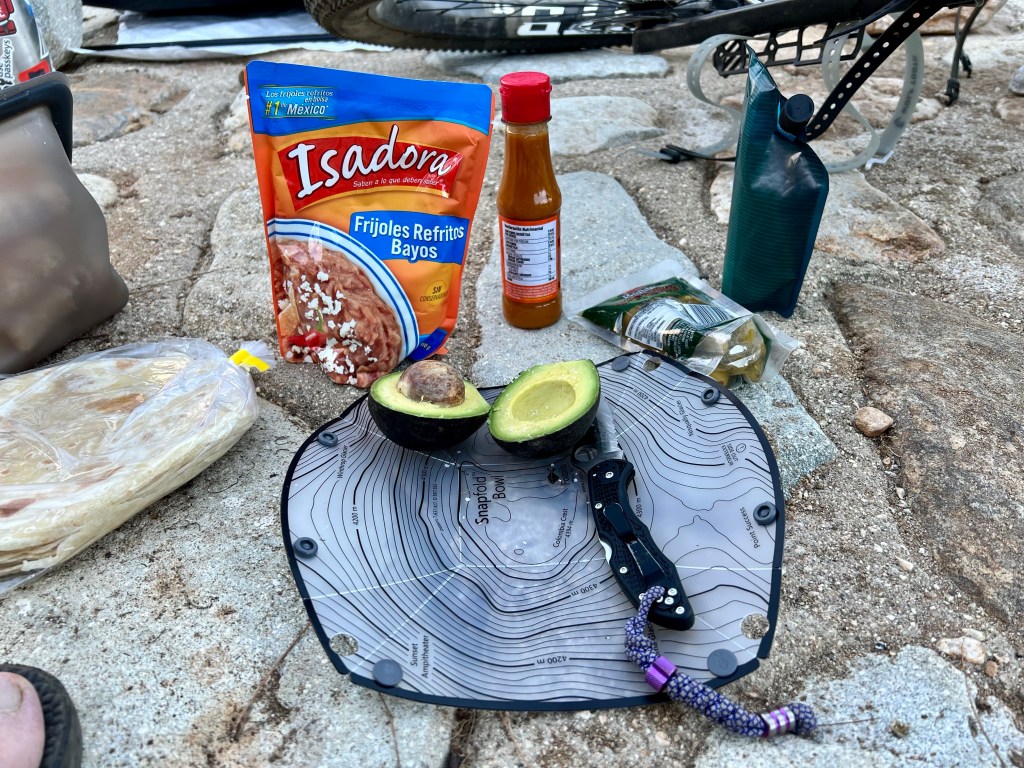
My campsite for the night.Dinner! Bagged beans, tortillas, an avocado, olives, and tequila.
On January 1, I left on the morning flight to San José del Cabo. I was incredibly anxious about my bike – will it make it on the flight? Would it be damaged en route?
When I arrived in Mexico, I noticed the bag had been opened. The TSA had searched my bag. I’m fine with the bag being searched, but I’m displeased that they tried to remove my framebag, and broke a few pieces of padding between the franebag and frame, and left the bike unsecured in my bag. I have no idea what they were looking for – nothing was removed. Thankfully, nothing was damaged in transit.
I called the Cactus Inn Hotel where I was staying, they directed me to the area just outside the terminal where the rental car agency folks wait. They had a representative there for their car rental business (Cactus Rentals) who drove me a few miles to the hotel. I checked into my simple, bare bones room before heading off to buy groceries and get dinner.
Tacos at Taqueria el Fortachon.
Well fed, I headed back to the hotel to rebuild my bike, repack my bags, and head off the next morning. Tequila was involved, so building the bike took longer than expected. (More on this in two days…)
Off to bed early for my first day of riding in the morning!
(Nota bene: All posts for this trip are being back dated to the date that they occurred, even if I’m writing a few days later.)
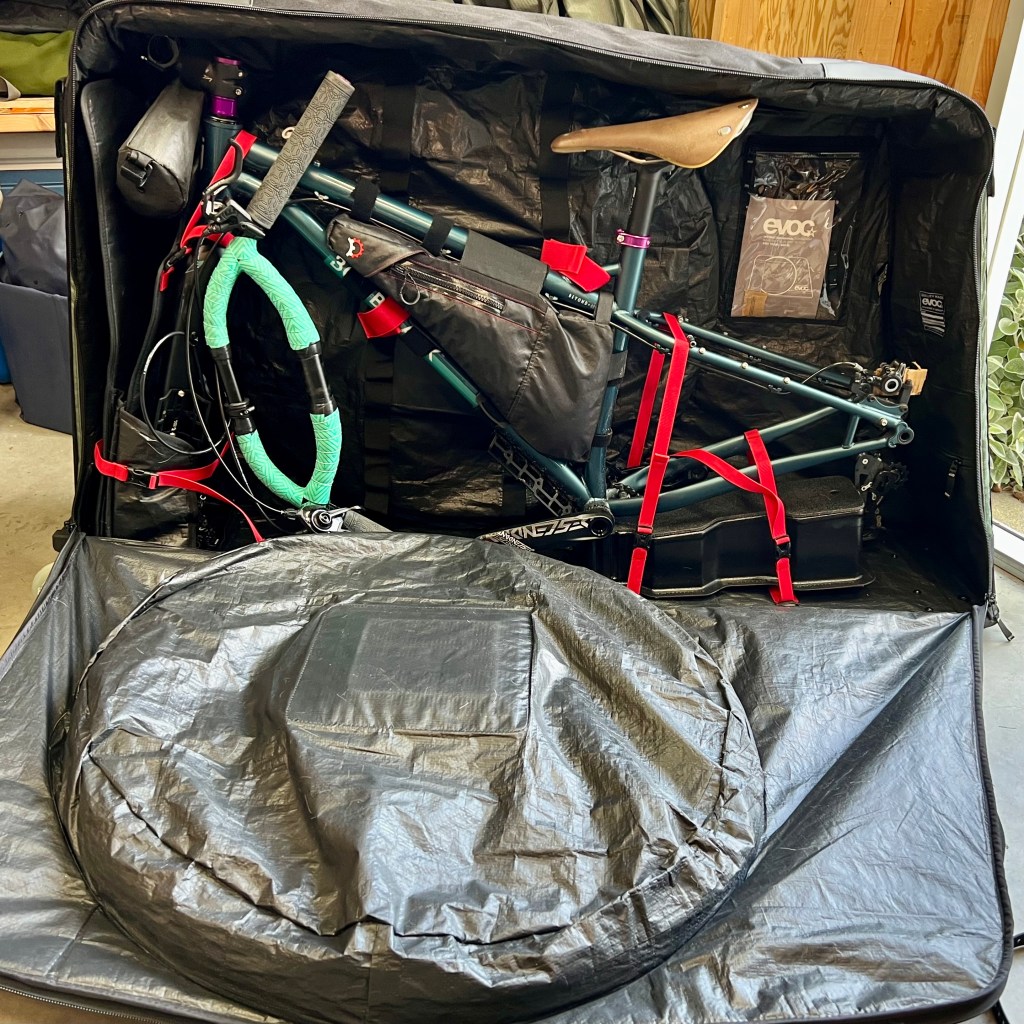
Last weekend I took some time to try packing my bike in it’s new travel bag, an Evoc Bike Travel Bag XL. Packing my bike taught me a few things. First, use only the tools you plan on bringing with you. If you cannot pack and unpack with those tools, you need more tools. My Crankbrothers M19 tool is sufficient to pack and unpack, it rides in my toolkit on every ride. A set of Wera L keys, Wera bicycle set, and a 15mm wrench are MUCH easier to use and faster, too. The Park Tool ATD1.2 torque wrench is a nice to have. Latex gloves to keep from getting dirty are always a good idea.
Second, the order of operations is important: Pedals come off first, then wheels. Thru axles are replaced front and rear to protect the fork and frame. Spacers are placed in the hydraulic brake calipers. Handlebars are removed last and strapped to the frame. Rear derailleur is removed (optional, but desirable). Finally, the seat post is lowered. At home I can do this in a repair stand which makes it convenient. On the road I’ll be working on the floor.
Placing the bike in the bag has a specific order, as well. The rear wheel is placed in the bag (on the side opposite the bike) first. Pedals are placed in an interior pocket along with tools. Next the bike frame gets mounted and strapped in place inside the bag. Any other gear is loaded into the bag and the side is zipped up, allowing the front wheel to be stored. As long as it’s under 70 pounds with everything is secured inside, it’s ready to fly.
There are a few items I still need to work out. I didn’t expect to have to remove the rear rack given the small size of my frame, but it did not fit as mounted. Next time, I’m going to try to tip the rack forward so that it stays mounted on the frame and only needs to be rotated back into place and secured. I’m still debating whether to remove the disc rotors before travel. They appear well protected in the bag, but a bent rotor could end a trip if I can’t fix it or find a replacement.
 Bikepacking for Nerds
You must be logged in to post a comment.